


Estate: Raise the Realm

Updated: Aug 17

I might use the word ‘Everdell’ more than once in this review… but that isn’t necessarily a bad thing.
Estate: Raise the Realm
Designers: Devon Grodkiewicz & Kathryn Hahn
Publisher: Grod Games
2026
Overview:
If you’ve played Everdell, then you are in more than familiar territory with this worker placement, engine building, tableau making, medieval / fantasy themed game from Grod Games, designed by Devon Grodkiewicz & Kathryn Hahn.
Over the five rounds of Estate: Raise the Realm you’ll find yourself placing out workers to gather resources, spending those resources to play cards into your tableau and generally trying to combo the heck out of everything that you do! Will you also be able to wangle extra workers down from the big 3D castle perched atop of the main board to do even more resourcey/ worker placementy / card playing good stuff? Hopefully!
A key wrinkle: Each card you play increases your engine in a specific area. Maybe you will power up your resource gathering abilities? Maybe you will increase the number of cards you can snaffle up from the shared display? You get the idea…
Each round will have a variable, game changing effect (either a tasty ongoing bonus or a less tasty ongoing restriction to contend with). At the end of the fifth ‘Era’, count up the scores from the cards you managed to play in your tableau (as well as one or two other point scoring bits and bobs) and keep your fingers crossed that you have done enough to emerge victorious.
Medium weight, possibly a smidgeon more ‘medium light’. Quick set up, rulebook was a doddle. So far so good...
Solo Headlines:
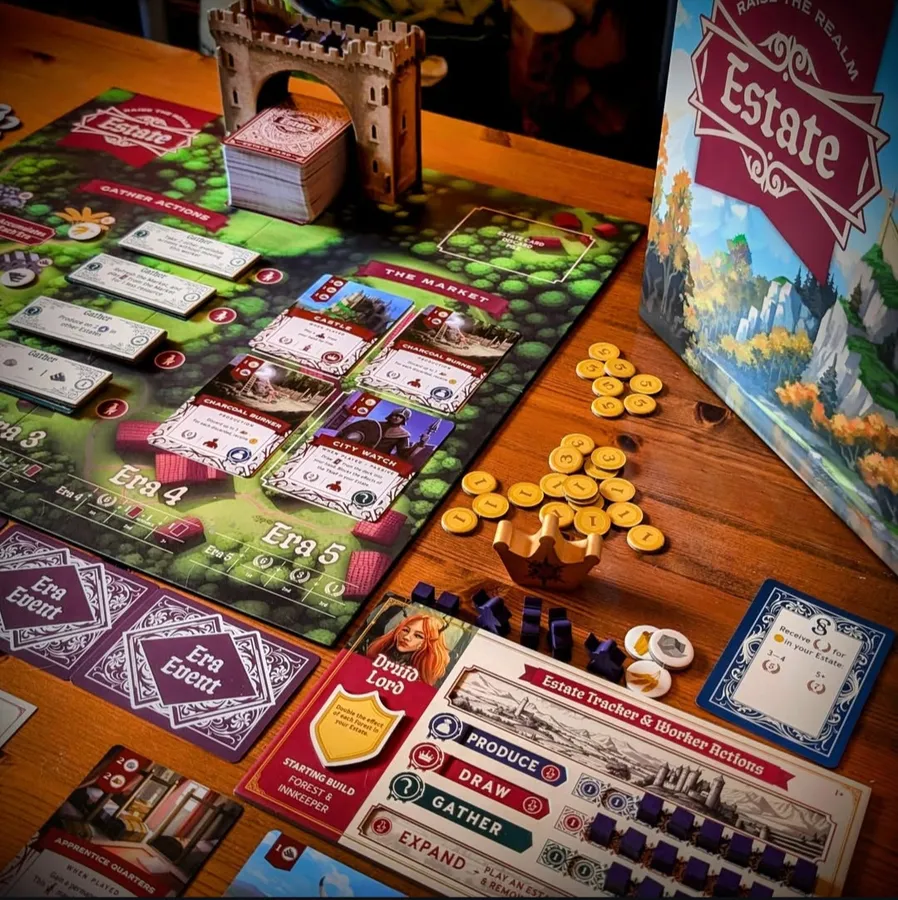
Estate’s solo mode gets right out of the way and simply lets you ‘play the game’. No solo opponent to manage, no decision trees to work through, no lengthy separate solo rulebook to peruse. Starting pistol goes off, grab your workers, take your turns, see how high you can get your final score to go.
Before any ‘Beat Your Own Score’ haters run immediately screaming for the exit door, Estate also does that really simple trick that adds a nice amount of ‘more’ to chew on: win conditions. I liked this approach in Guild of Merchant Explorers and I like it again here. At the start of each of the five ‘Eras’ (rounds) of the game, flip over the randomised solo objective that you are trying to achieve that round. You have absolutely zero idea of what might be waiting for you – just flip the solo objective for that specific era and go hell for leather towards trying to achieve it. Get to the end game with fewer than three of those win conditions completed and the giant ‘Loser Klaxon’ goes off. Ouch. Better luck next time. Win conditions always ramp up the tension for me in any game – but particularly in the low-stakes world of Beat Your Own Score, they are a more than welcome addition.
OK, there is an element of occasional luck going on – some of the win conditions that reveal themselves at the start of each round might serendipitously be just the exact thing you had already been working towards. Or more often, it might leave you screaming, “If only I had known this was coming up, I could have done something about it.” But therein lies a nice balance of those ‘highs and lows’ that I appreciate over the course of a good Euro game. Is it particularly hard to achieve the win conditions? Not especially. Do they make hitting the upper echelons of the scoring thresholds harder? You bet they do!!
I might have liked the solo mode to do a teeny tiny bit of arbitrary blocking of spaces or snaffling up of resources over the course of the game – if only to give me a couple of “aaaaargh, I really wanted to go there / get that” moments that required me to do a tactical pivot or three. Nothing, though, that a house rule and a six-sided die or two wouldn’t solve if the fancy took me.
All told though, Estate sits well within my 60 minutes or less solo sweet spot, is engaging enough to keep me happy and light enough to keep me reaching for it when I’m wanting something that isn’t going to make my brain melt.
General Headlines:
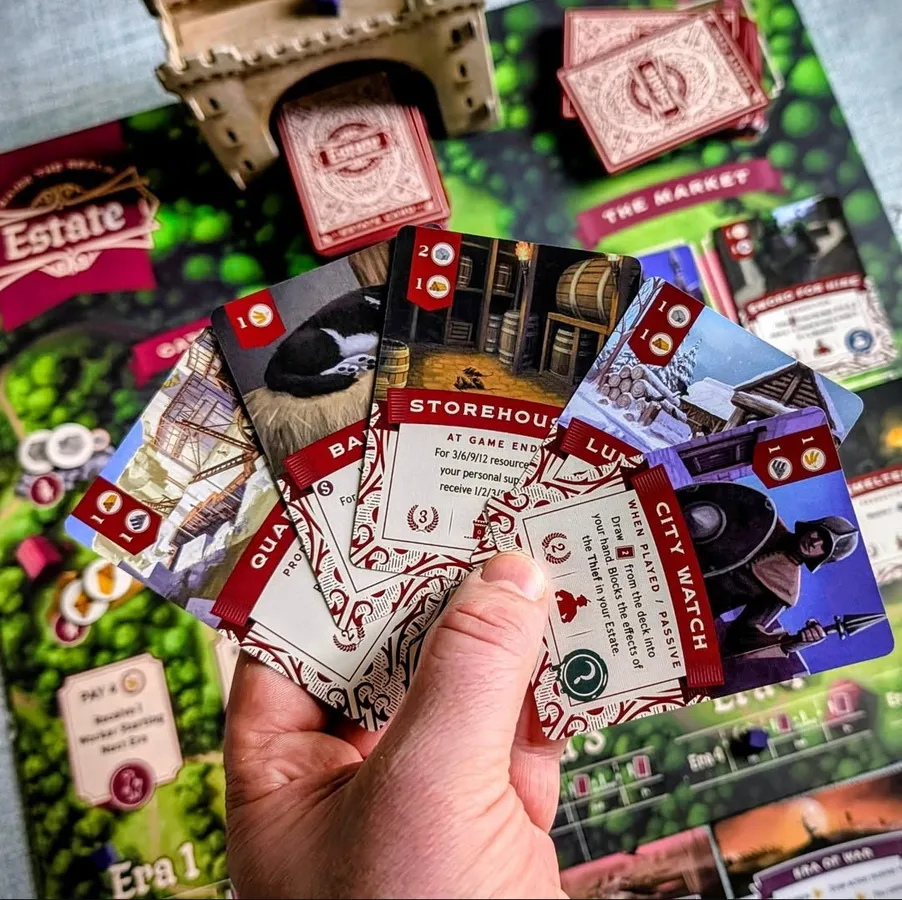
You might not have realised at first glance from the cover that Estate: Raise the Realm has a ‘fantasy’ theme — I missed this myself and initially thought things were firmly ‘medieval’ in tone. But nope: plenty of mages, sorcerers, and other characters are peppered throughout the game. Some appear on the many cards you can snaffle up to play into your tableau, while others are the characters you play as, with your asymmetric player boards.
The first expansion for Lost Ruins of Arnak absolutely spoiled us with its phenomenal cast of characters and their astonishingly thematic asymmetric player powers, which forced you to change your strategy massively from game to game. Things are a lot more subtle here; however, those gentler nudges and differences are welcome and offer a little bit of variety game to game.
Other than the front cover perhaps not conveying the fuller theme of the game, the artwork is nice and thematic throughout. Is it building a world as strongly as the art in Everdell or Scythe? Maybe not, but I still enjoyed exploring what was on offer.
Gameplay-wise, things felt comfortingly familiar — I wouldn’t suggest adding Estate: Raise the Realm if you’re looking for wildly innovative take on all things ‘Euro’. But I don’t want all of my games to break the mould. I like familiarity, warmth, comfort food… I like more of what I like. Estate: Raise the Realm gives me a medium-light game that I can bring out when I don’t want a big brain-burner, while still offering just enough of the elements I know I’ll enjoy — a smattering of worker placement, lots of nice combos, and cursing the day I was born because I have one wood when all I really need right now is one stone. Lots of things to smile about: fun combos to trigger, that really nice wrinkle that each card you play into your tableau increases your power in a specific part of your game…heck even that nice 3D castle giving a nice bit of table presence (albeit without any functional use) during gameplay.
Most of all however, Estate: Raise the Realm just wears its heart on its sleeve and simply asks you to enjoy its familiar, comforting charms.
At a Glance:
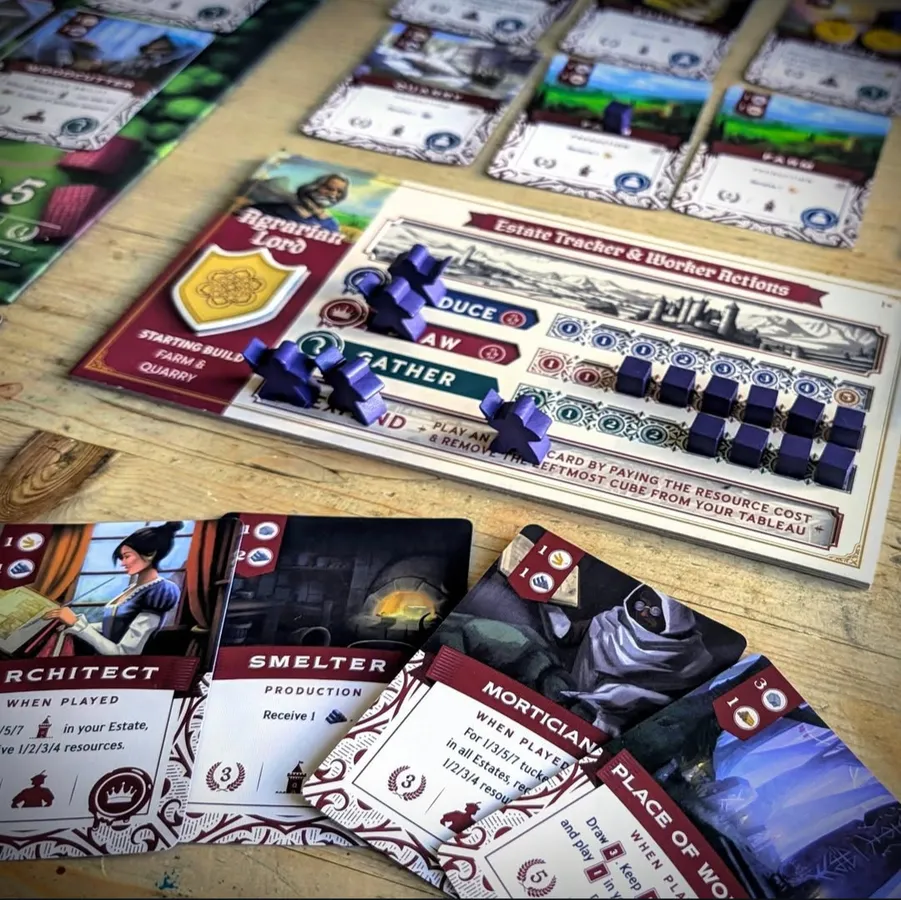
Estate: Raise the Realm is a familiar feeling medium-light tableau builder that retains all of the combo-bursting goodness that I like in a game of this style. Plays solo in under an hour, is quick to get up and running, and keeps me engaged throughout. It wears its Everdell influence firmly on its sleeve…and that’s not a bad thing. For those that might find the cute anthropomorphic theme of Everdell off putting (though you would have one extremely cold and dark heart) then Estate: Raise the Realm might just be the right alternative to consider.
Final Score:
7.5 out 10
Reviewed after 6 plays (3 solo, 3 two player)
***Review copy provided by the publisher*** Read more about this game at BoardGameGeek


Comments