


Euphoria: Essential Edition


Fashionably late to the party
Euphoria Essential Edition
Designer: Morten Monrad Pedersen, Jamey Stegmaier, David J Studley
Publisher: Stonemaier Games
2026
Overview:
A combining together of Euphoria: Build a Better Dystopia (2013) with its Ignorance Is Bliss expansion, alongside an updated main board and a few minor rules tweaks here and there. Here in this colourful dystopian city you'll have workers (those lovely chunky dice) at your disposal.
On your turn you'll either place workers onto the main board or bring back some (or all) of the workers you've already placed out on previous turns.
Ponder which of the four regions on the main board that you'll send them to: Euphoria, Subterra, the Wastelands or Icarus. Some spaces can be shared with other players. Some spaces allow you to bump other players' workers out. Sometimes only one worker can visit a specific space. Sometimes the value of your die matters enormously. Other times it's simply a bun fight to get any worker there at all. Heck, some spaces even let you acquire more workers.
Of course, that meagre resource you acquired in one area inevitably needs to be spent somewhere completely different, meaning the decision of where to place and when soon turns into a very tasty puzzle.
Retrieving your workers also creates an equally thorny dilemma. Each time you bring workers back, you'll reroll their dice. Higher dice means greater ‘Knowledge’. Sounds good, right? Not necessarily. You don't want your dystopian workers becoming too knowledgeable or else they might begin to realise they're little more than pawns under your control and decide to break free. As a result, you'll lose a worker. Darn it. Some difficult decisions therefore emerge around whether to retrieve and reroll all of your workers once you've run out... or whether to only bring some of them back. Indeed, some dice you'll actively want to leave out on the board because they're busy helping you with longer-term plans.
There are tracks to climb too, with all players contributing towards their progress. Perhaps one of those tracks will eventually unlock your asymmetric player power? Best get moving then!
Mainly though, you'll be trying to place all ten of your stars before anyone else manages to do so.
You'll earn them from reaching the end of tracks, trading in artefacts you've discovered along the way and, perhaps most commonly, by helping construct various buildings throughout the city. Multiple players can contribute towards those constructions, and those who did get rewarded with a star when the building is completed.
Those who didn't?
Well, they'll find themselves suffering an ongoing penalty until they eventually get around to placing a star there themselves. Slow and incremental. Gather some resources. Move up some tracks. Build some constructions. Slowly but surely place those stars.
The first player to place all ten wins.

Solo Headlines:
What a nifty solo mode this turned out to be.
I had two initial pauses for concern. The first was knowing that I would need to be controlling two automa rather than one (Gulp - surely this is going to be time-consuming and take longer than my own turns?). The second was a cautionary note in the rulebook: "There can be a bit of a learning curve associated with a couple of the automa actions, but these will soon click and play will become as smooth as butter."
A learning curve, you say? And one that is so steep it needs specifically flagging in the rulebook? Double gulp.
I didn't need to worry at all. Those two automa are super simple to operate. Flip a card, very quickly glance at it and place a die for each of them onto the main board where indicated (or indeed take some or all of their dice back). Turns took seconds. Sure, there was a little bit of "in these cases it places its lowest / highest value die" stuff to internalise before playing that first solo game, but nothing too onerous.
I say that, but back to that note of caution in the rulebook about there being a learning curve. The truth is that, as I read some of the automa priorities in the rulebook, there was some head-scratching and uncertainty. I just couldn't visualise those priorities and didn't feel clear at all about what the automa was supposed to be doing. But reading words on a page and playing the actual game are two very different things. The truth is that things were indeed obvious and as ‘smooth as butter’ as once I was actually playing. Clear cases of "Well, of course it HAS to do X, Y and Z." I was flying in no time.
The automa is racing to spaces, clamouring to get stars out, climbing tracks, honing in on specific areas, pulling its dice back at the right time and leaving dice out at even better times. It felt great and, perhaps most importantly, it felt like a really close race and battle to get those stars out before it did.
The standard difficulty level felt just right, but there are tweaks available for those wanting a greater (or lesser) challenge. Games landed nicely within my usual 60-minute (or thereabouts) solo sweet spot too.
Breezy automa. Fun solo game. Nice challenge. I enjoyed.
Worth noting too that the automa can also be added to a two-player game to add a little more competition for spaces and places, effectively replicating a four-player game with minimal additional overhead.

General Headlines:
I'd often looked at Euphoria and pondered whether to add it to the collection. The truth is, I just never quite took the final plunge. The original release required an expansion for solo play and, while I enjoy taking the occasional punt on a game, even I have my limits when it comes to taking a punt on both a base game and an expansion at the same time. Then along comes Euphoria: Essential Edition, bundling the solo mode, expansion and various tweaks into a single package. Consider my attention fully grabbed.
Perhaps I'd absorbed a few too many lukewarm reviews over the years. Perhaps I had convinced myself that a game originally released in 2013 would inevitably feel a little dated alongside more modern worker-placement designs. If anything though, I found the opposite.
What struck me almost immediately was how fresh Euphoria felt. Not because it is doing wildly complicated things by today's standards, but because it feels noticeably different from many of the worker-placement games that now dominate the hobby. There is an interactivity here that I wasn't expecting and a constant sense that opportunities are emerging, disappearing and being fought over. Small tactical decisions emerging every single turn. There always seemed to be another track to advance, another space to race towards, another opportunity to exploit or another player power worth leveraging. That constant stream of possibilities kept the game feeling lively throughout.
Turns aren’t massive here. Fans of exploding combos might leave disappointed. There are important turns for sure. But you can expect turns to just involve getting a couple of resources and then the next turn, spending those resources on a move up a track. It’s a slow incremental build of a game. You’re not getting too lost in turns. You’re planning out in your mind four or five small moves and willing that plan into fruition (or watching it crumble into the sea along with your hopes and dreams).
I also quite enjoyed having some sacred cows challenged. The stuck in the mud Euro gamer in me likes a Victory Point. I like collecting them, counting them (I tap each hard won point out on that VP tracker when it moves up. EVERY. SINGLE. ONE) and discovering which clever combination of mechanisms produced the biggest pile by the end of the game. Euphoria doesn't really care about any of that - the entire game is a race to place stars. Simple
…at least in theory.
What I found in practice was that the absence of points creates a very different atmosphere. Progress feels tangible. Every star matters. Every opportunity to place one feels significant. You're never really wondering whether you're winning by seven points or losing by twelve. You're simply trying to reach that finish line before everyone else. It can make the ending feel abrupt though – there were games where I knew I had zero chance of winning before the final turn came around and so I threw in the proverbial towel. I suspect that would frustrate me in a multiplayer game. In solo play though I wasn’t too bothered.
One particularly lip-licking decision space reminded me of the wonderful Tzolk'in: The Mayan Calendar (great in its own right and, for fans of strategic goals, even better with the excellent Tribes & Prophecies expansion). The core turn structure here in Euphoria sees you either placing a worker or retrieving some (or all) of the workers you already have out on the board. “Ooooohhh. Do I leave that one lone worker out there just a little while longer so that it can perhaps do one more useful thing for me before I bring it back? Or do I pull it back immediately and open up more options elsewhere?” Love it. In Tzolk'in, that decision is all about leaving workers out to strengthen as the giant Mayan wheel slowly turns. Here, it's more about keeping your options open, securing spaces and trying to avoid pushing your ‘Knowledge’ level too high and losing one of your workers as punishment. That whole decision space is one of the game's biggest selling points for me and one of the things that makes it stand out from the usual 'place all your workers, retrieve all your workers' worker-placement formula. The ability to bring back some of your workers, but not necessarily all of them, creates a wonderful amount of flexibility and gives Euphoria an identity all of its own.
I have to say I was also more than impressed by the quality of the components and the nice, functional insert inside the box. I don't know why I was surprised - Stonemaier Games always knock the production quality out of the park. Maybe there was just something in my mind making me think that "Essential" = "less than". I suspect that's a hangover from games like those in the Everdell series, which have a deluxe Collector's Edition alongside an Essential Edition that is positioned as the more basic offering. Anyways, nothing basic about this one. Chunky wooden components, thick card stock, a great insert and a production that never once felt like corners had been cut. Impressed.
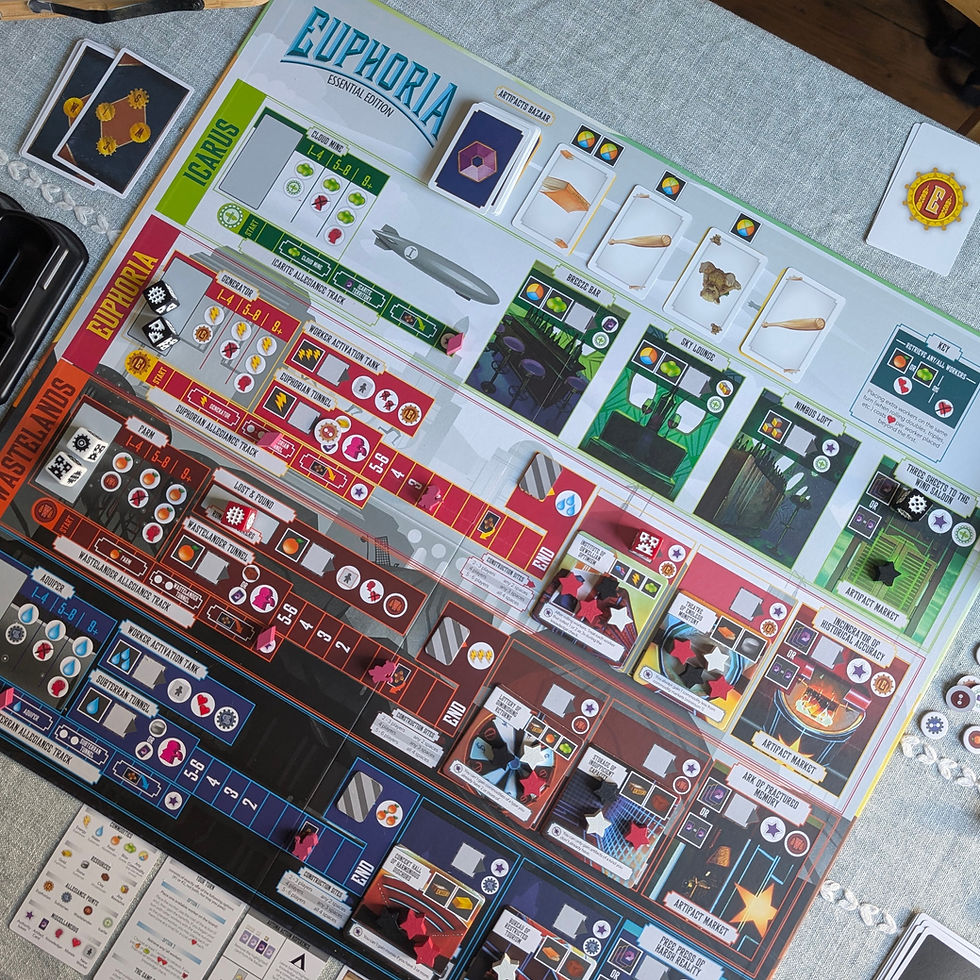
I'll happily play a beiger-than-beige Euro all day every day, but I do also enjoy a snazzy, colourful change from time to time. Euphoria certainly delivers on that front – you almost need sunglasses to protect your eyes from the colour! In this Essential Edition, I'm aware that the board layout has changed from the original 2013 release. It's subjective, of course, but I get the sense that a few fans of the OG version prefer the older board. Any such changes are largely irrelevant to me though. This is the only version I've ever known. Sure, it looks and feels functional and perhaps a little procedural, with everything grouped neatly into distinct areas rather than trying to build a sprawling immersive world. But what it lacks in thematic artistry, it more than makes up for with those bold splashes of colour and functionality. Everything is easy to see, easy to parse and easy to understand at a glance.
It's also completely unnecessary and has zero impact on the game itself... but I tell you what, I'm always a sucker for a game that has a double-sided main board with alternative artwork. I like it in Brass: Birmingham. I like it in Oak (well, the Deluxe Edition). I like it here in Euphoria: Essential Edition. It adds absolutely nothing. Well... perhaps on this greyer side of the board things are slightly easier to parse. It's just a small, inconsequential extra that is never anywhere near a deal breaker for me, but I always get weirdly delighted when a game includes alternative artwork on the reverse side of the board.
All told, I’m really glad that this more ‘solo friendly’ Essential Edition finally tipped me over the edge into trying what turned out to be a really enjoyable experience. I love it when a game catches me off guard.
Euphoria absolutely did that.
At a Glance:
Euphoria: Essential Edition caught me completely off guard. What I expected to be an ageing worker-placement game from 2013 instead felt fresh, interactive and packed full of small but meaningful decisions. The race to place stars creates a surprisingly tense alternative to traditional VP accumulation, while the worker placement and retrieval system gives the game an identity all of its own. Add in a wonderfully breezy solo mode that mimics a fuller player count with minimal overhead and there is an awful lot to like here. It may not be a game of giant combo explosions or sprawling strategic plans, but its constant stream of opportunities, races and tactical decisions kept me thoroughly engaged throughout. One of the more pleasant surprises to hit this solo table in quite some time.
Final Score:
8.5 out of 10 (Reviewed after 5 plays)
***Review copy provided by the publisher***


Comments