


Finspan

Updated: Mar 22
Fin-tastic.

Finspan
Designers: David Gordon & Michael O’Connell (Solo Mode: David J. Studley)
Publisher: Stonemaier Games
2025
Overview:
With plenty of fish and a fair few sharks thrown in for good measure, you’ll be sinking your teeth into more than a few chewy decisions over the four rounds of Finspan, designed by David Gordon & Michael O’Connell and published by Stonemaier Games. Each round consists of six turns, and on each turn you’ll be doing just one of two things:
• Play a fish card from your hand onto your player board
Your board represents a thematic ocean diving site, and of course, certain fish can only be placed in specific zones. Some species prefer the sunlit shallows; others lurk in the darkest depths. More often than not, the cost of placing a fish is other cards from your hand. Choices, choices… which cards do you play, and which do you burn?
• Or send your diver down your board
Instead of playing a card, you can move your diver down through your player board, triggering the abilities of previously placed cards it passes. Maybe those abilities let you add new fish cards to your hand, retrieve cards from your discard pile (rewarding clever sequencing and planning), or more commonly, spawn eggs onto fish and eventually hatch them into young. Get three young on the same space and convert them into a school for some tasty end-game points.
Over the course of the game you will encounter cards with immediate bonuses, cards that trigger when your diver swims through them, and cards that only activate during end-game scoring. You’ll also score points at the end of each round from variable strategic goals—think “2 points for each completed row of fish” or “1 point for every egg on your board,” and you’re in the right territory. Reach the end of the game and tally a satisfying chunk of points from the printed values of all the fish you’ve played, along with those big, rewarding schools you’ve managed to build.

Solo Headlines:
As you’d expect from a title by Stonemaier Games, Finspan includes a solo mode from the Automa Factory. More on that in a moment, but the first thing that struck me after setting up the game and reading through the rulebook in preparation for my first playthrough was that there wasn’t an official option to play a simple ‘beat your own score’ (BYOS) solo mode with a few arbitrary thresholds to aim for.
I’m not suggesting this instead of the official solo mode - I’m suggesting it in addition to the existing, fuller solo experience.
You see, Finspan is a game with little to no interaction between players. It’s very much a “head down, focus on your own game, and after about an hour everyone looks up to see who scored the most” kind of experience. Sure, there are some very light attempts at interaction - “if you activate this thing on your board, all players at the table may also do that same thing” type stuff - but overall, Finspan is one of the most ‘multiplayer solitaire’ games I’ve ever played. Let me be clear: this is not a bad thing. I love multiplayer solitaire games. I am a solo player. They sing to the beat of my heart! Here is a game you can literally unbox, set up, and start playing solo without the need for any bot or additional solo rules (okay, maybe one or two exceedingly minor house rules), and just start trying to achieve the highest score you can. Sure, ‘beat your own score’ games aren’t for everyone, but when a game can truly be played one-handed, straight out of the box (similar to the splendid Newton) then why not explicitly make it an official option?
On the plus side, while the rulebook doesn’t tell you that you can play this as a simple BYOS, you are the boss of you, and it’s great that Finspan can indeed be enjoyed this way.
…and truth be told, the official solo mode isn’t that much more involved than a beat-your-own-score approach anyway. Don’t misunderstand me - it’s very cleverly put together and unbelievably simple to operate, with Automa turns that take a fraction of a second thanks to a quick card flip and an at-a-glance action. But Finspan isn’t a game with meaningful player interaction, so the solo mode isn’t trying to replicate a human opponent who might thwart your plans as you play. It simply gathers “stuff” each turn and then converts it into a variable number of points at the end of the game, based on your chosen difficulty level—of which there are plenty to suit all abilities.
I’m probably making it sound like I had a negative solo experience with Finspan. The truth is, I thought the game was absolutely wonderful and I’ll continue to reach for it regularly as a solo game. It’s accessible, quick to get to the table, has enough bite to keep me thinking – and really hits that perfect ‘don’t want something too heavy but still want enough to chew on' sweet spot. Streamlined but still satisfying. Its just I’m also aware that players who crave more interaction, or who want a solo mode that genuinely mimics another human player—and who shy away from BYOS games or more straightforward solo systems—may want to look elsewhere. They would be missing out on an excellent solo experience I might add, but I completely understand that not every game is for everyone.
One thing I particularly liked about the solo mode in Finspan though was the optional ‘Ravel’ mode. Again, it’s not going to be for everyone - but it’s optional, so you can simply leave it out if it’s not your thing. In Ravel mode, you’re told upfront: “If you place cards in these specific spots, you’ll lose points, but you can mitigate that by placing cards in these other spots.” It adds a nice extra layer of overarching strategic tension and gives you more to ponder. You’ll have plenty of “I really need to play this particular fish in this particular row, but AAAARRRGH - I’ll lose 4 points if I do!” moment, You get the idea. I liked Ravel mode. I might not use it every time, but I’m glad it’s there as an optional twist.
All told, I loved this one.
General Headlines:
If you’d told me a year ago that I’d fall in love with a lighter, fish-themed relative of the wildly popular Wingspan, I’d probably have squinted at you, shrugged, and wandered off to set up something heavier. Wingspan was a ‘like, not love’ game for me, and I used to be firmly stuck in that old “heavier games = better games” rut. Not my proudest habit, but we live and learn!
It was probably Everdell Farshore that quietly rewired the way I looked at lighter, more streamlined games. Farshore proved that ‘lighter’ doesn’t have to mean ‘lesser’ - it can actually mean sharper, more focused, dare I say…more enjoyable. So when I also started hearing people talking about Finspan in the same breath - “more focused,” “cleaner,” “easier to get going,” “a more distilled take on Wingspan” - my curiosity was well and truly piqued.
And honestly? Finspan wasted absolutely no time making a good first impression. I had the box open and the game rolling in what felt like seconds - largely thanks to the Dized tutorial. I had never encountered Dized before, but one quick scan of a rulebook QR code later and I had this amazingly helpful learn-as-you-play app open and teaching me the game. I’m not the best at learning games from rulebooks and often find myself watching (and rewatching) playthroughs to get a feel for a game. Here, I was up and running and playing almost immediately. Brilliant. I’d love to see Dized learn-as-you-play tutorials in every game!
Once Finspan is properly underway, you realise that while the rules are feather-light there are more than a few meaty decisions presenting themselves everywhere you turn. There’s the tactical pivots that you are forced to make when you realise that the card you really want to play can only be played in a completely different area than where you want to it go. There is the angst filled choices of which cards you will have to remove from the game as a cost to play another card. Those moments when you realised “aaargh, I have ran out of cards all together”. Decisions too on whether to play cards with immediate bonuses or cards that will activate when you diver moves through them. When to play cards vs when to send divers down them. Just excellent choice after excellent choice.
There are two games happening at the same time in Finspan. The first is that enjoyable card-play and card-activation puzzle. The second is a lovely spatial puzzle: where to spawn eggs / when to hatch them into young / how to move those young across rows and columns so you can gather three in one place to form a point-tastic school of fish. It would be a relatively simple puzzle if you weren’t also finding yourself desperately needing to spend those eggs and young as a cost to play cards from time to time. Planning moves three or more turns ahead to make sure the right egg hatches in the right place at the right moment = Delicious.
I might have tired after a game or two of just playing cards and hatching eggs. It’s enjoyable, but I can see how it might start feeling repetitive after a while. Enter the excellent end-of-round strategic goals, which change from game to game. There’s a generous stack of them. One round you might be racing to create schools of fish, the next you’re trying to form rows of fish, and the round after that you’re collecting as many cards of a specific type as possible. Then the next game, all of those objectives change! The variety is strong enough that every play feels just a bit different from the last as you chase new targets and discover little synergies between your overarching strategic goals. It kept things fresh, which is exactly why Finspan kept hitting the table for play after play - and why it’s likely to become a regular feature here in the Headlines from a Solo Player house from this point forth.
And that’s the ongoing magic: Finspan is so quick to set up, so easy to remember, and so smooth to play that it continuously invites you back. I’d categorise it as ‘lighter but still thinky’—that sweet spot where you don’t necessarily want a big brain-burner, but you still want something to chew on. It nails that niche beautifully.

At a glance:
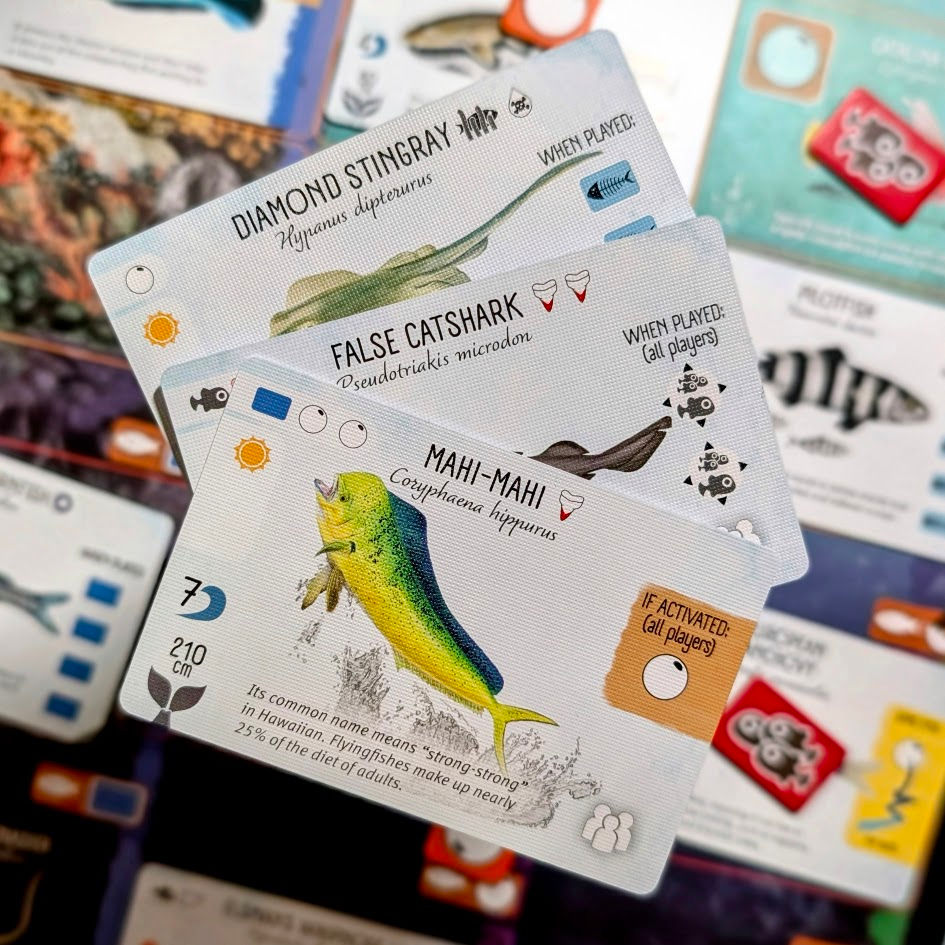
Finspan surprised me in all the right ways. It’s quick, clean, accessible, and has just enough to chew on to be genuinely satisfying. Full of aquatic charm, wonderful artwork, a super simple solo mode - it would be such a shame if it was overlooked or dismissed in favour of its bird themed older sibling. If smart, satisfying, elegantly pared-down mechanisms and lovely strategic goal chasing sounds appealing Finspan absolutely deserves a place on your radar (or should I say, sonar?)
Final Score:
8.5 out of 10
Reviewed after 10 plays (7 solo, 2 two player, 1 four player)
***Review copy provided by the publisher***


Comments